


 Global









Low Clamping Protection Solution for 48V Power Systems
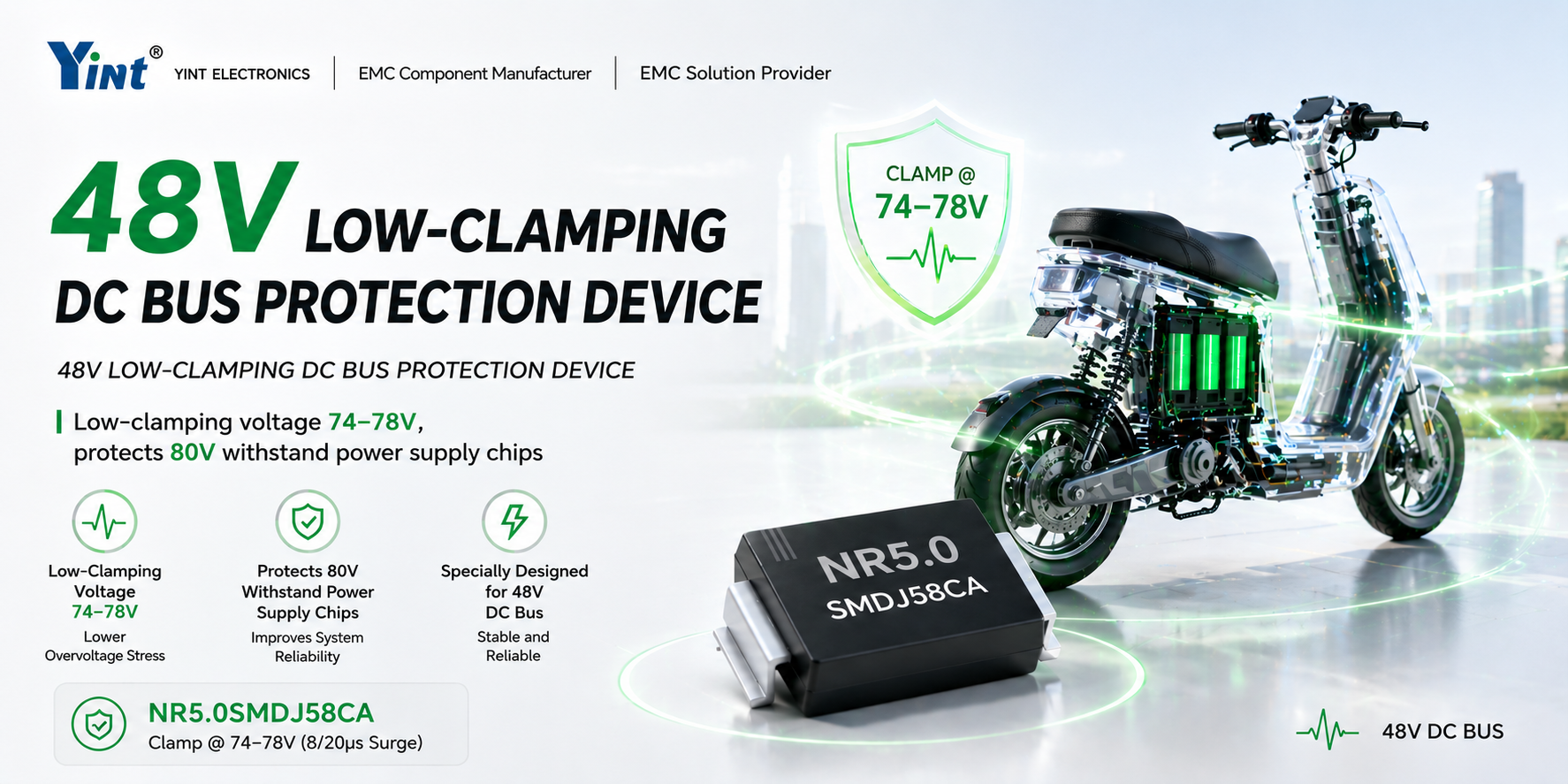
The NR5.0SMDJ58CA is a low clamping TVS surge protection device designed for 48V power systems, suitable for new energy vehicle 48V onboard power supplies and PoE power systems. The design goal of this device is not simply to pursue higher nominal power, but to control the clamping voltage of the bus/power supply line at a lower level within the critical surge current range, closer to the safe operating window of DC-DC converters, power management ICs, PoE PSE/PD controllers, and network port protection chains, thereby reducing system-level risks such as breakdown, avalanche degradation, repeated EMI triggering, reset, and disconnection.
Part 1: Industry Pain Points
48V New Energy Vehicles/Mild Hybrid Systems: Standards vs. Real-World Conditions Are "More Stringent"
In 48V power systems, the design challenge for TVS surge protection is not whether basic protection capability exists, but whether the clamping voltage can be controlled within the acceptable safe window of downstream devices under real surge current conditions.
48V onboard power supply is transitioning from "local auxiliary power" to broader power distribution (mild hybrid/new energy platforms, electronic power steering, pumps/fans, domain control, etc.). The industry commonly uses LV148 as the basic framework for 48V onboard power supply testing and verification, covering scenarios such as voltage fluctuations, load transients, and energy accumulation overvoltage.
In addition to OEM proprietary specifications, automotive electronics generally need to consider ISO 16750-2 (electrical load/voltage stress) and ISO 7637-2 (supply line conducted transients). In actual vehicles, motor feedback, relay/contactor switching, harness inductance, and ground loop uncertainty superimpose to form high dv/dt and high di/dt spikes.
Power IC process pain points: smaller line widths, thinner gate oxides, and higher integration make the "voltage withstand window more sensitive." Many failures are not immediate breakdowns but latent failures caused by gate oxide stress, avalanche degradation, and increased leakage current (efficiency drop, temperature rise, repeated reset/power loss).
Ethernet PoE Power Supply: Also a 48V System, but Failure Modes Are More "Port and Cable" Oriented
Under the IEEE 802.3af/at/bt framework, PoE typically uses 48V as the nominal supply voltage, with a common operating voltage range of 44–57V. PSE/PD must complete detection, classification, power-up, and maintenance processes. Ports experience hot swapping, cable charging/discharging, and uncertainties from external device connection.

Typical pain points for industrial PoE/outdoor PoE come from lightning-induced surges and remote surge coupling. Although isolation transformers exist, transients can still couple into the system. The industry often uses IEC 61000-4-5 (1.2/50μs voltage/8/20μs current) surge waveforms for system-level immunity verification.
The contradiction of traditional TVS: for general power, clamping voltage is too high or dynamic resistance is too large. During the surge current rise phase at the PoE port, the voltage at the protected DC-DC/controller may still be elevated to a dangerous zone, causing port power loss, handshake failure, PHY damage, or long-term reliability degradation.
Common Challenge: The "Safe Window" for 48V Systems Is Becoming Increasingly Narrow
Whether for automotive 48V or PoE 48V, these are essentially "high-energy, low-voltage" systems: energy is rapidly injected via current, and system survival often depends on clamping voltage (Vc) and dynamic response, not just the nominal VRWM.
Therefore, the market demands: while ensuring surge withstand capability, lower and more predictable clamping voltage under critical surge current conditions (window protection).
For low-clamping TVS selection in 48V power systems, focus on dynamic resistance, clamping voltage, and compatibility with automotive electronics protection and PoE surge scenarios.
The design approach is to reverse-engineer key device parameters based on the actual surge waveform of the 48V system and the withstand voltage window of the protected device:
Low Dynamic Resistance (Rdyn) Priority: During surge current rise, the system terminal voltage approximates V ≈ VBR + I·Rdyn. Smaller Rdyn yields lower clamping at high currents, keeping voltage within the target window.
System-Oriented, Not Single-Device: Simultaneously consider supply fluctuations and transient characteristics from automotive LV148/ISO 7637-2/ISO 16750-2, as well as PoE port hot-swap, cable energy, and IEC 61000-4-5 surge verification methods.
Low Clamping + Easy Implementation: Based on customer habits with 58CA/60CA/64CA grades, provide lower-clamping, window-closer upgrade options to reduce change costs.
Reliability-Oriented: Emphasize leakage control, batch consistency, and predictable failure modes for automotive/industrial customers to establish quality closed loops.
This low-clamping TVS solution applies to new energy vehicle 48V onboard power and PoE power systems, achieving more stable voltage limiting across different surge protection scenarios.
A. New Energy Vehicles / 48V Onboard Power Systems (LV 148/ISO Related)
48V Bus Entry/Branch: DC-DC front-end protection, domain control/actuator power entry, 48V→12V conversion link input side
Typical Threats: Load transients, motor regeneration, harness inductance spikes, contactor switching-induced energy overvoltage
Target Benefits: Lower bus spike clamping voltage, reduce overvoltage stress and avalanche degradation on downstream DC-DC/power ICs, minimize resets and abnormal power-down
B. Ethernet PoE Power Systems (IEEE 802.3af/at/bt + IEC 61000-4-5)
PoE PSE (Switch/Midspan) Ports: Power pair entry, PD controller and front-end rectification/hot-swap path
PoE PD (Camera/AP/Terminal) Side: Port front-end protection, DC-DC input side, outdoor/long-cable induced surge path
Typical Threats: Port hot-swap, cable discharge, outdoor lightning-induced surge coupling into ports; under IEC 61000-4-5 1.2/50–8/20 waveforms, the protection chain must both "withstand" and "clamp."
C. Core Advantages (Three Key Takeaways for Customers)
Lower Clamping: Under critical surge current, clamp 48V supply line voltage lower, closer to the protected chip/module's safety window
Stronger System Stability: Reduce DC-DC overvoltage triggers, port power-down/disconnection probability, improve overall reliability and consistency
Low Implementation Cost: Compatible with 58CA grade usage habits, layout and application compatible with traditional TVS, enabling quick replacement and upgrade
D. Application Recommendations
Placement: Prioritize near the "energy entry point" (automotive bus branch entry, PoE port entry) with shortest loop; ensure low-inductance ground/return path
Hierarchical Energy Limiting: In high-energy environments (automotive/outdoor PoE), combine with fuse/PTC, series resistor/inductor, and secondary clamping to form hierarchical protection, avoiding single-point energy absorption
 Hot News


 沪公网安备31011702889749号